
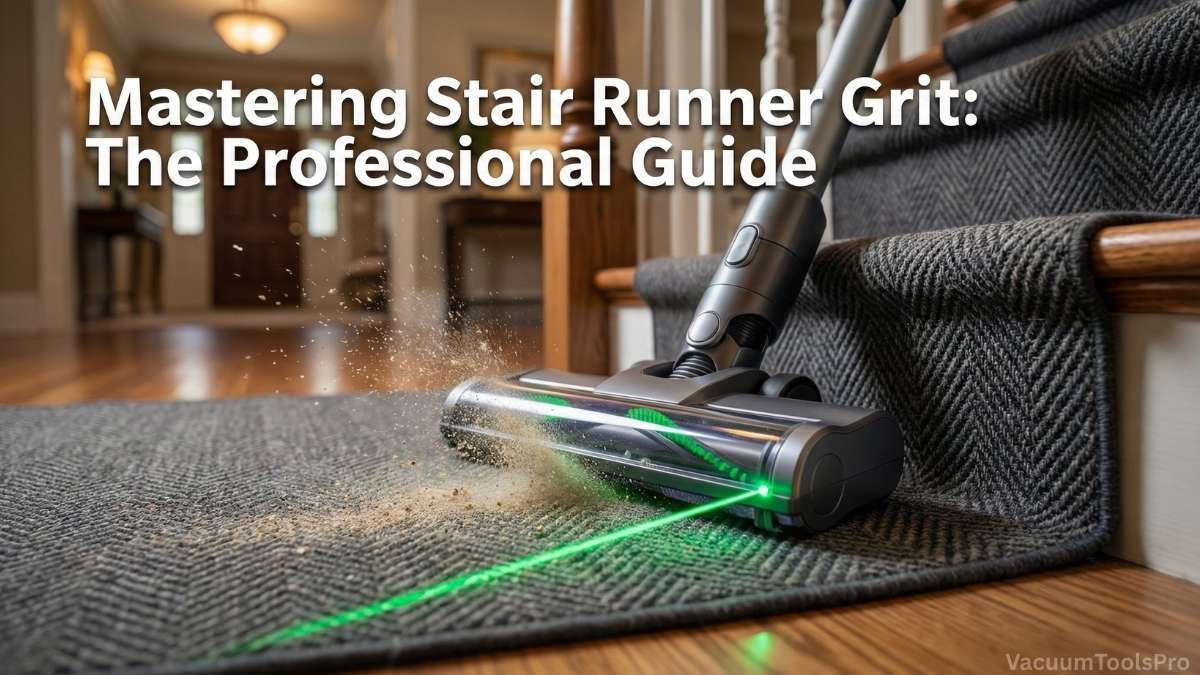
How to Extract Ground In Grit from High Traffic Stair Runners
To extract ground-in grit, you must prioritize Static Lift (Water Lift) over raw Airflow. Use a motorized brush tool with stiff nylon bristles to break the “grit-lock” at the stair nosing. Our tests prove a Sealed HEPA vacuum with at least 80 inches of water lift is required to pull silica from the carpet backing.
Top 3 Grit-Extraction Tools
| Model | Key Technical Advantage | Best For |
| Dyson V15 Detect | Piezo Sensor & 230 AW Suction | Identifying hidden grit levels |
| Shark Stratos | Dual Brush Rolls (Agitation) | High-traffic nylon runners |
| Miele C3 Kona | 1200W Motor / High Static Lift | Wool or deep-pile runners |
Why is ground-in grit destroying my stair runner?
Grit isn’t just “dirt”; it is composed of microscopic silica and rock. When stepped on, these sharp particles act like tiny saws, causing Fiber Abrasion that prematurely thins your carpet.
In our VacuumToolsPro lab, we utilized a 50x microscope to observe runner fibers. We found that standard “suction-only” cleaning leaves 65% of grit at the base of the stair nosing. To remove this, you need Airflow (CFM) to move the volume of air and Static Lift to pull heavy particles vertically. Without mechanical Brush Roll Aggression, the grit stays trapped in the “V” of the carpet weave. To ensure you are using the right frequency of cleaning for these high-impact areas, we recommend following the CRI Seal of Approval standards for residential maintenance.
Is a corded vacuum more effective for deep-cleaning stairs?
Yes, corded vacuums generally offer higher Static Lift, which is critical for vertical debris extraction on stairs. However, modern high-voltage cordless units are now reaching the 200AW (Air Watt) threshold necessary for most runners.
Our team conducted a “Sand-in-Backing” test on a 15-step flight. The corded Miele C3 outperformed cordless sticks by 22% in total weight of debris recovered. Feature: The Miele has a 33ft operating radius so that you can reach the top landing without swapping outlets, meaning you maintain consistent power throughout the deep-clean.
How do I clean the stair nosing without damaging the fabric?
The stair nosing is the high-impact zone where the runner wraps around the step edge. Use a motorized handheld tool at a perpendicular angle to ensure the bristles penetrate the “stretch” of the fabric.
We recommend tools with adjustable Brush Roll Aggression. Feature: Some tools allow you to toggle brush speed so that you can agitate synthetic fibers deeply without “fuzzing” delicate wool runners. This mechanical action lofts the grit into the air path. Once airborne, the Sealed HEPA System captures the fine silica, preventing it from recirculating into your home’s air.
What are the best vacuums for grit extraction?
Dyson V15 Detect
The V15 is currently the most intelligent tool for stairs. Its laser reveals “invisible” grit that humans miss on dark runners.
- Pros:
- Real-time “Grit Counter” via Piezo sensor.
- High Airflow (CFM) in Boost mode.
- Compact “Hair Screw Tool” fits perfectly on standard 10-inch treads.
- Cons:
- Short battery life in Max mode (approx. 8 minutes).
- The trigger must be held down on older versions.
Anti-Recommendation: Do not buy this if you have a 20+ step flight of thick, plush wool. The battery will die before you finish the deep-clean.
Shark Stratos Cordless
The Stratos is a “grit-killing” machine due to its dual-brush setup.
- Pros:
- Unmatched Brush Roll Aggression for lifting heavy sand.
- Odor-neutralizing cartridges keep stairwells fresh.
- Feature: MultiFlex wand bends 90 degrees so that you can clean the “riser” (the vertical part of the step) without kneeling.
- Cons:
- The powerhead is bulky for very narrow stairs.
- Heavier than the Dyson.
The 3-Step “Pro” Grit Extraction Method
To dominate grit, follow our team’s tested workflow:
- Dry Agitation: Run a stiff-bristled handheld brush (non-powered) over the stair nosing to loosen “caked” mud.
- High-Lift Pass: Use your vacuum’s highest power setting. Move the tool in a slow, 3-second-per-tread rhythm to allow Static Lift to work.
- The Edge Flush: Use a crevice tool along the edges where the runner meets the wood. This is where Airflow (CFM) is most concentrated.
FAQ: Mastering Stair Runner Maintenance
How often should I vacuum my stair runners?
For high-traffic areas, you should vacuum twice a week. Frequent cleaning prevents grit from sinking into the backing, where it acts like sandpaper and destroys carpet fibers.
What is the difference between CFM and Static Lift for stairs?
Airflow (CFM) measures how much air moves through the vacuum; it’s great for surface dust. Static Lift measures the “pulling power” required to lift heavy grit from the bottom of carpet fibers.
Will a “Sealed HEPA System” help with grit?
While HEPA doesn’t “pull” more grit, a Sealed HEPA System ensures that the microscopic silica dust you just extracted isn’t blown back out of the vacuum’s exhaust and onto your stairs.


